
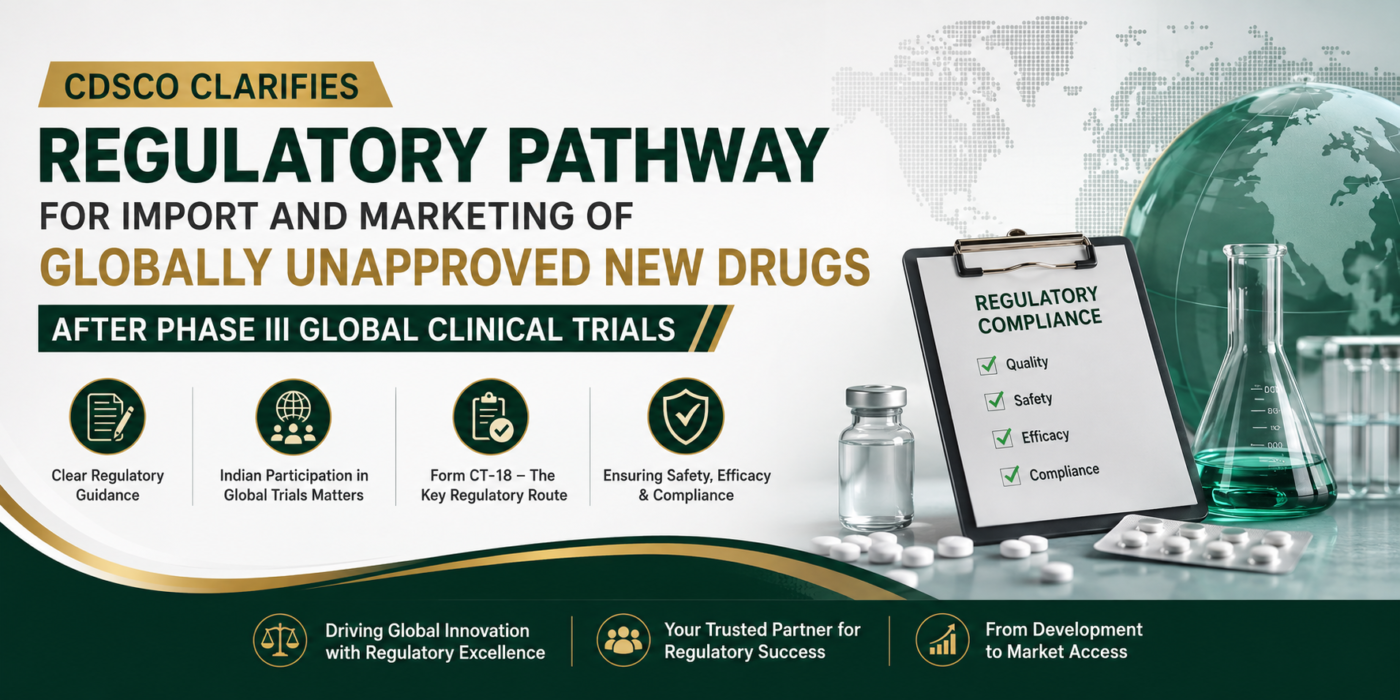
CDSCO Issues Guidance for Importing and Marketing Globally Unapproved New Drugs After Phase III Trials
On August 10, 2026, the Central Drugs Standard Control Organisation (CDSCO) put out new guidance for companies hoping to import and market new drugs in India that haven’t yet been approved anywhere else. This update matters most to pharma and biotech sponsors who’ve run a Phase III clinical trial—including Indian patients—but lack global approval.
So, what’s going on? Under India’s New Drugs and Clinical Trials Rules, 2019, drugs that haven’t been approved anywhere in the world count as “investigational new drugs.” The challenge: even if you’ve wrapped up a Phase III global trial (with Indian subjects), you can’t just march ahead to sell the drug in India. There’s a strict process you have to follow.
Clinical Trials Are Not the Same as Marketing Approval
Just because you’ve completed a Phase III global trial doesn’t mean you have a green light for marketing. That trial helps build evidence for safety and efficacy, but the leap to actually selling the drug is a whole other step. Clinical trial permission and commercial import rights are two separate things, and the rules don’t let you skip steps.
So, even after your successful Phase III trial, you still need to submit Form CT-18 if you want to import and market the drug. CDSCO will review your application under Rule 75. If all goes well, they’ll give the go-ahead via Form CT-19 or CT-20.
Here’s the basic path:
1. Submit Form CT-18 for commercial import.
2. CDSCO reviews everything.
3. If approved, you get permission under CT-19/CT-20.
Even if you already got clinical trial permissions, you can’t use those as a shortcut—the authorities need a full package for marketing approval.
Why Indian Participation in Global Phase III Trials Matters
Bringing Indian subjects into global phase III trials can really help your case. Data from Indian patients means you can show evidence that’s relevant for the local population, which may speed up the regulatory review.
But—just participating in a Phase III trial doesn’t mean you’re off the hook for further regulatory requirements. You still need to include a full development package, showing you’ve satisfied all Indian standards.
Getting Ready for Marketing Approval
When you’re preparing your submission, be crystal clear on the drug’s regulatory status. Your application needs to explain:
– That the drug isn’t approved anywhere else.
– That the Phase III trial had proper authorization.
– Whether the trial is ongoing or wrapped up.
– That Indian subjects were actually part of the study.
– That the data from your trial applies to Indian patients.
Why does this matter? Submitting for a globally unapproved drug is a different process than for one already approved elsewhere. CDSCO expects a complete dossier—not just a clinical study report. You need to cover:
– Quality info (manufacturing, controls, stability, etc.)
– Non-clinical safety data
– All clinical data (phases I, II, and III, plus Indian subject data)
– Integrated safety and efficacy info
– Regulatory status from other countries, if applicable
– Proposed labeling and risk management plans
Think of it this way—CDSCO wants enough information to make its own, independent decision about the drug.
For Multinational Companies and Indian Partners
If you’re a global sponsor or working with an Indian licensee, this update is important. Having India as part of the global Phase III program means you’ll likely find it easier to support your future submission here. Just remember: participation is helpful, but you still need to jump through all regulatory hoops.
A smart sequence looks like this:
1. Add India to your global development plan.
2. Ensure Indian subjects are in your Phase III trial.
3. Collect robust clinical data for Indian patients.
4. Submit Form CT-18 with the full package.
5. Get CDSCO’s green light.
Planning Ahead Helps
If you’re eyeing the Indian market, don’t wait until after your global program is done. Plan early. Think about:
– Should India be in your global trial?
– Is your Phase III study design providing Indian-relevant data?
– Are you prepared to meet all Indian CDCSO requirements?
– Do you have everything needed for a solid CT-18 submission?
Lining up these details early can save you a lot of headaches later.
What You Should Do Now
If you’re developing a globally unapproved new drug, take these steps before you apply for marketing authorization in India:
1. Pin down your drug’s regulatory status—confirm it’s still unapproved worldwide.
2. Review your Phase III trial. Did you get enough robust Indian data?
3. Make sure your development package covers every angle—quality, non-clinical, and clinical.
4. Don’t mix up clinical trial authorization with marketing approval—they’re very different.
5. Prepare your CT-18 submission, making sure you tick all the boxes in Rule 75.
6. Think about risk management and post-marketing obligations—plan ahead.
What’s the Big Takeaway?
CDSCO’s August 2026 memo makes one thing clear: a global Phase III trial (including Indian subjects) is only one step. If your new drug isn’t approved anywhere else, you still need to submit Form CT-18 and a complete data package for Indian marketing approval. Running the Phase III trial—even if you’ve finished it—doesn’t mean you can start selling.
For multinational sponsors, this means you should think about India from the start. Indian participation in global trials makes your eventual submission much stronger, but you still have to meet all India’s requirements.
Need Regulatory Support?
ACPL – Accredited Consultants Pvt. Ltd. offers end-to-end regulatory support for pharma, medical device, IVD, cosmetics, and more.
Email: info@acplgroupindia.co.in
Mobile: +91 92666 65201 | +91 93100 40434
Address: B3, Sector 6, Noida – 201301, Uttar Pradesh
ACPL: Your Trusted Partner for Indian Regulatory Compliance and Market Access.